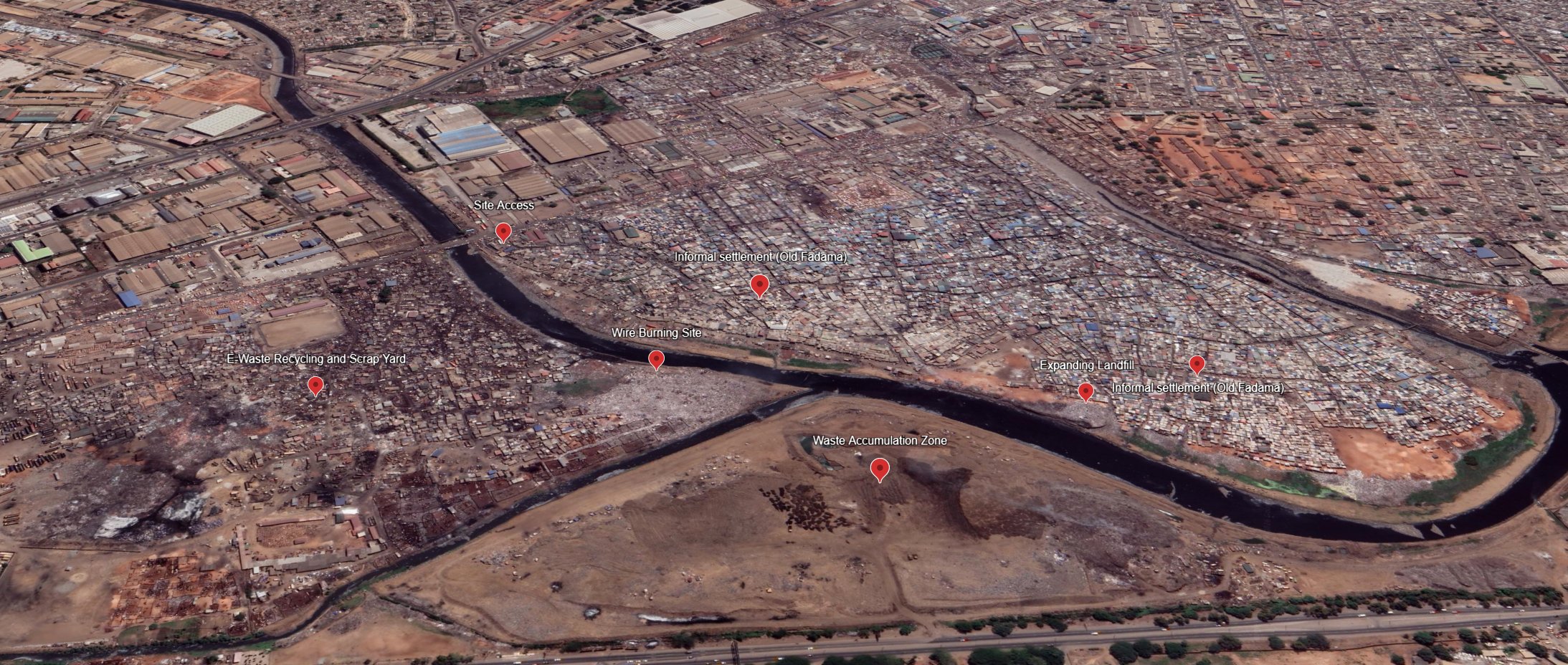
2021
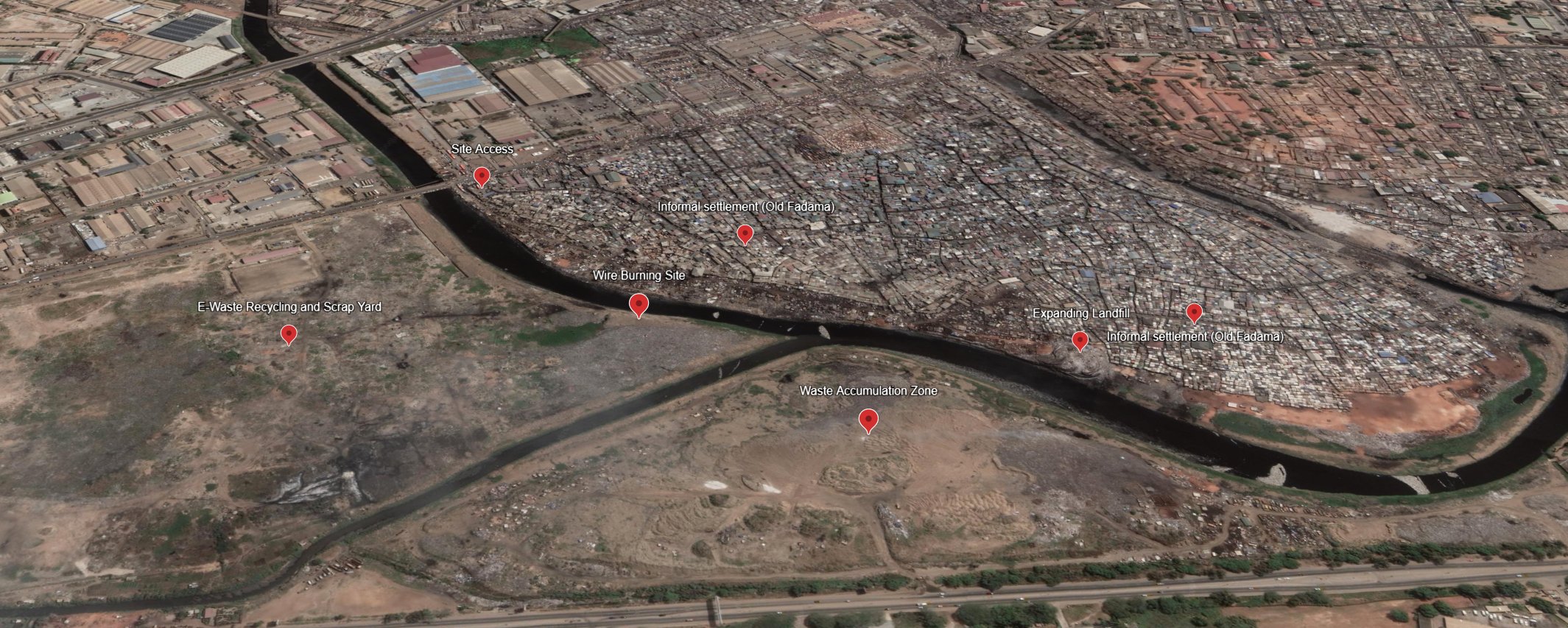
2023
The site was demolished in 2021 — bulldozed, fenced, declared finished. Headlines declared victory over what had been called the "world's most toxic dump."
But the fires never stopped.
They scattered, then regrouped. By 2025 and 2026, with political shifts and economic necessity, smoke rises again over Old Fadama and the edges of the Korle Lagoon. Dismantling and burning have returned — sometimes openly, more often in fragments pushed into the margins. The ecosystem held: survival built on poison, copper pulled from ash, children moving through soot. Formal recycling exists nearby, but the informal system never left. It continues to process thousands of tons each year.
What was once concentrated is now stretched across a wider, looser footprint, fragments of the old system stitched together with new growth. Some scrap yards feel hollowed out, with empty stalls still standing where business once moved faster. Elsewhere, new ones have taken their place.
Satellite imagery from the years following the demolition reveals a clear reintensification of activity — burn scars returning, informal structures spreading, and large accumulations of waste expanding along the edges of the site. On the ground, that shift is unmistakable. Beyond the scrap lanes, the trash rises higher than before, forming vast, uneven accumulations that now define the landscape more than the centralized burning fields once did.
It is not just electronic waste. The flow has widened — household refuse, plastic, organic decay — a broader stream of discard folding into the same terrain. Workers and residents say the same thing: the waste never stopped coming. If anything, there is more of it now.
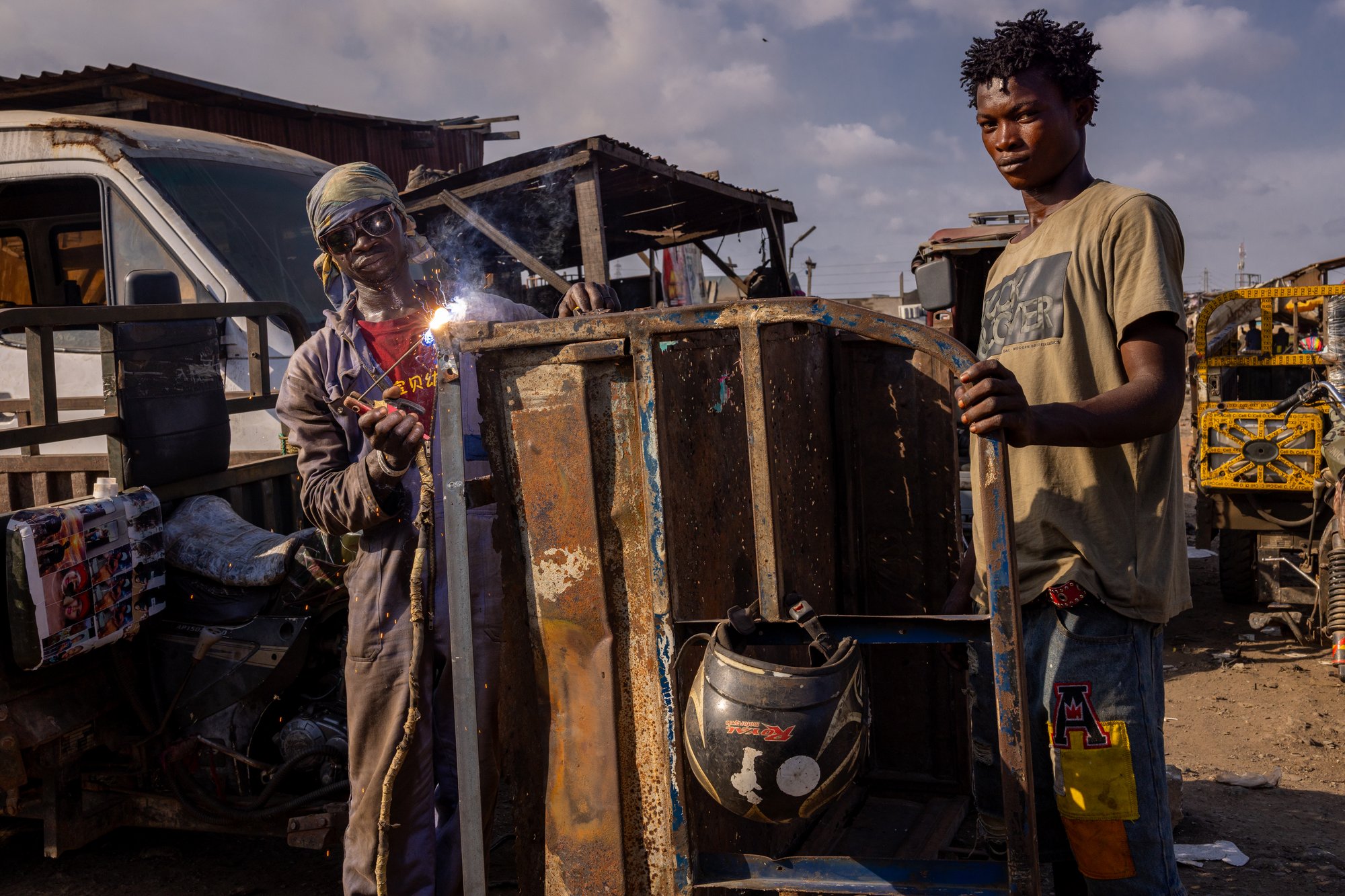
The road into Agbogbloshie is chaos. Motorbikes cut through narrow lanes, weaving around carts stacked with twisted metal and broken machines. Vendors sit behind stripped air conditioners, cracked refrigerators, compressors split open for what remains inside. The ground is black with soot, layered from years of burning.
Women and children sit low in the dust along the roadside. Many of the workers come from Ghana's drought-stricken north, where earning money here is still seen as opportunity. Survival is measured in copper grams and lungfuls of smoke.
There is also a kind of fatigue around the place. Agbogbloshie has been photographed, documented, studied — its images circulated widely. But access has changed. What was once more open now feels more guarded. Workers watch more closely. Questions are met with hesitation. Several people pointed to informal leadership within the site — gatekeepers who shape who moves freely. It is not a closed place, but it is no longer an easy one.
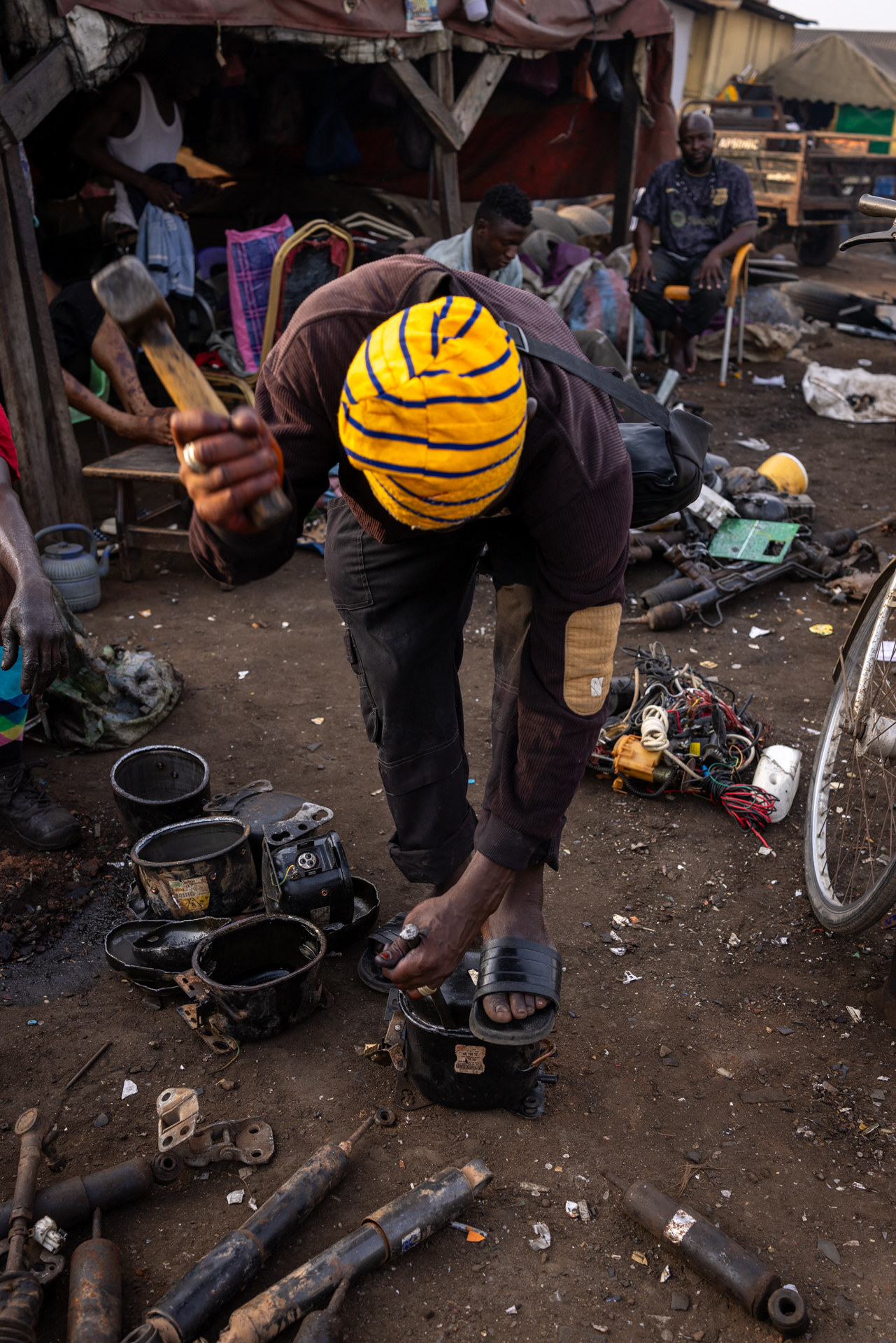
Inside the scrap market, a man crouches over a refrigerator compressor. With a hammer and chisel, he pries open the steel casing. Oil bleeds into the dirt. He strikes again, then pulls the copper coils free with his bare hands. Copper is the prize.
"Years back, Germans came. They watched us. Timed us. They said it takes too long."
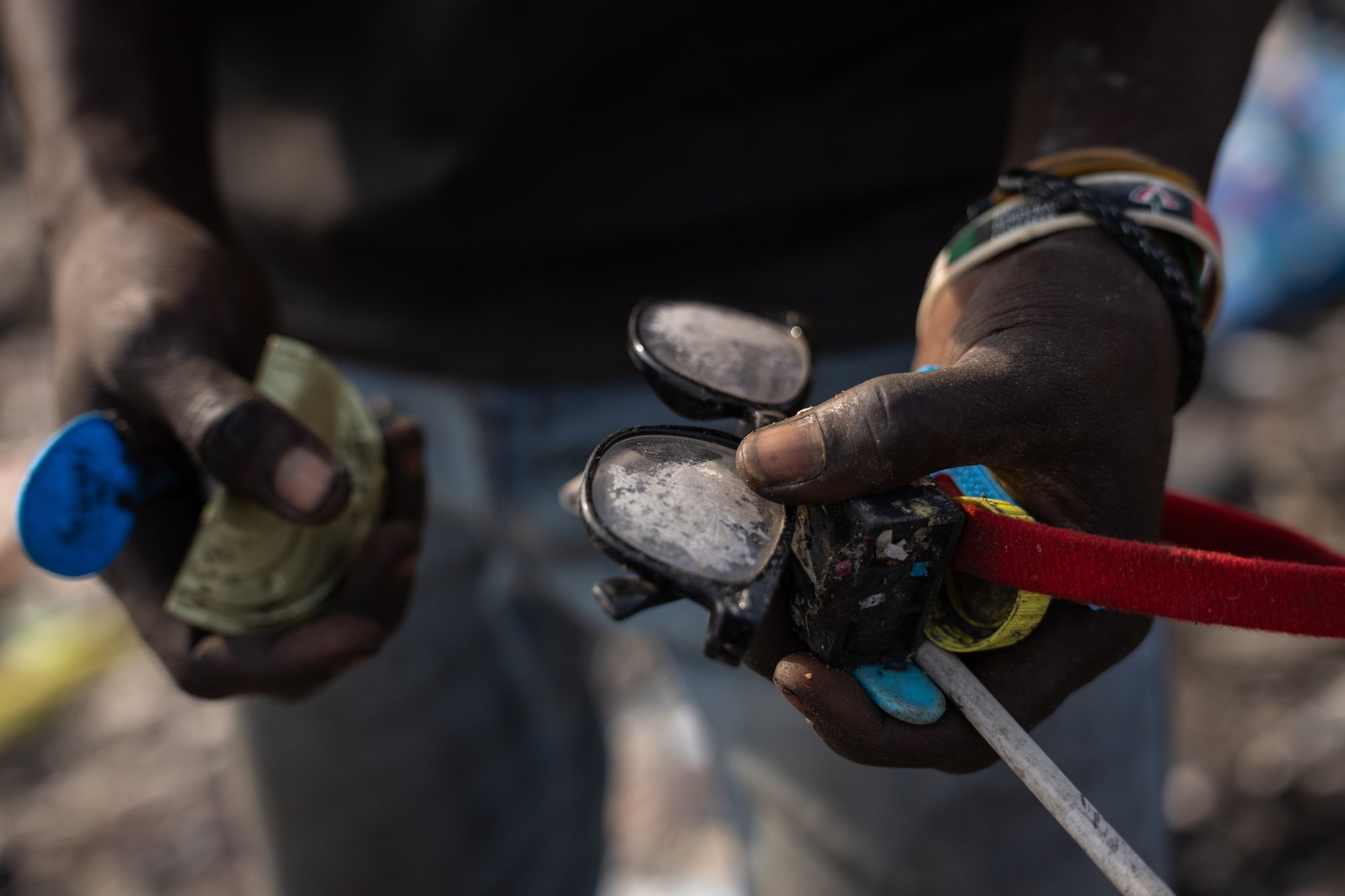
Beyond the scrap market, a hill of garbage rises. At its base, a small dog rests beneath a wooden stool, a chain glinting faintly at its neck. We climb. At the top, cows graze through plastic and rotting waste as if it were pasture. A boy approaches and shows what he has found — a handful of discarded sunglasses. He points at the Meta Ray-Bans on my face and laughs. In a place that exists because the world's thirst for the newest hardware is unquenchable, the presence of my smart-glasses feels heavy — a piece of the future looking down at its own graveyard.
Below, families cook over open fires. Women prepare food along the edges of the settlement while children move through the smoke — playing, running, kicking a worn football. Small food stalls line parts of the path. Cuts of meat sit out in the heat, unrefrigerated. A man stands over a plastic bag filled with goat, ready to be grilled, animated and proud of what he is preparing.
Life continues here, openly, in the middle of it. A naked child runs toward me and wraps his arms around my leg. For a moment, I freeze. He laughs, then runs back toward his parents, who watch from a few meters away. In a place defined by toxicity, the gesture feels dissonant — almost defiant.
This is where the burners work. Men arrive with sacks of wiring slung over their shoulders — burner boys, they're called.
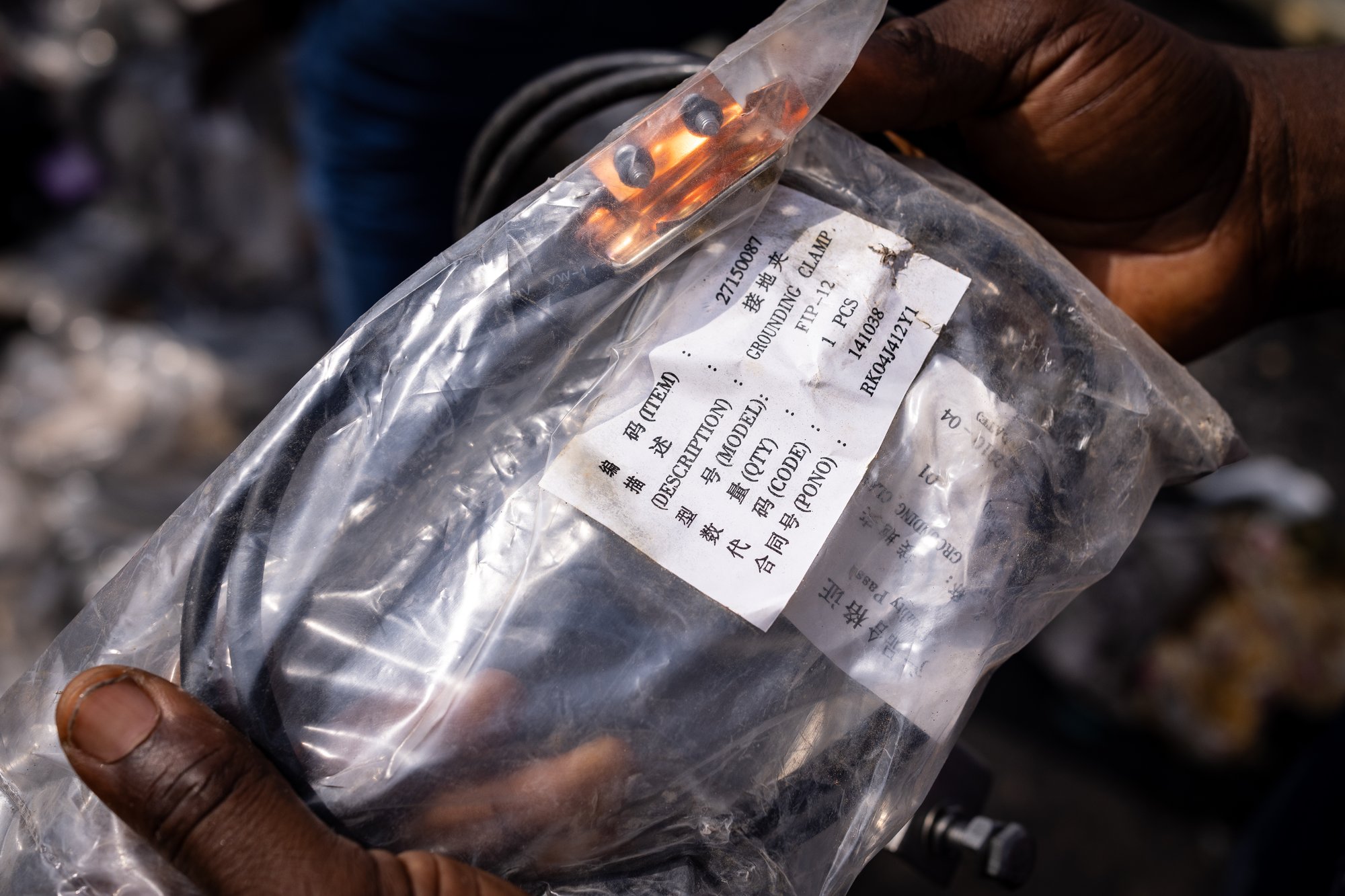
While much of this is e-waste, there is a newer, more suspicious element: some of the wire being fed into the flames is still in its original packaging. These are unused grounding wires, the packaging still marked with Chinese lettering. It is a clear sign that the site isn't just a grave for the old; it's a processing center for the stolen.
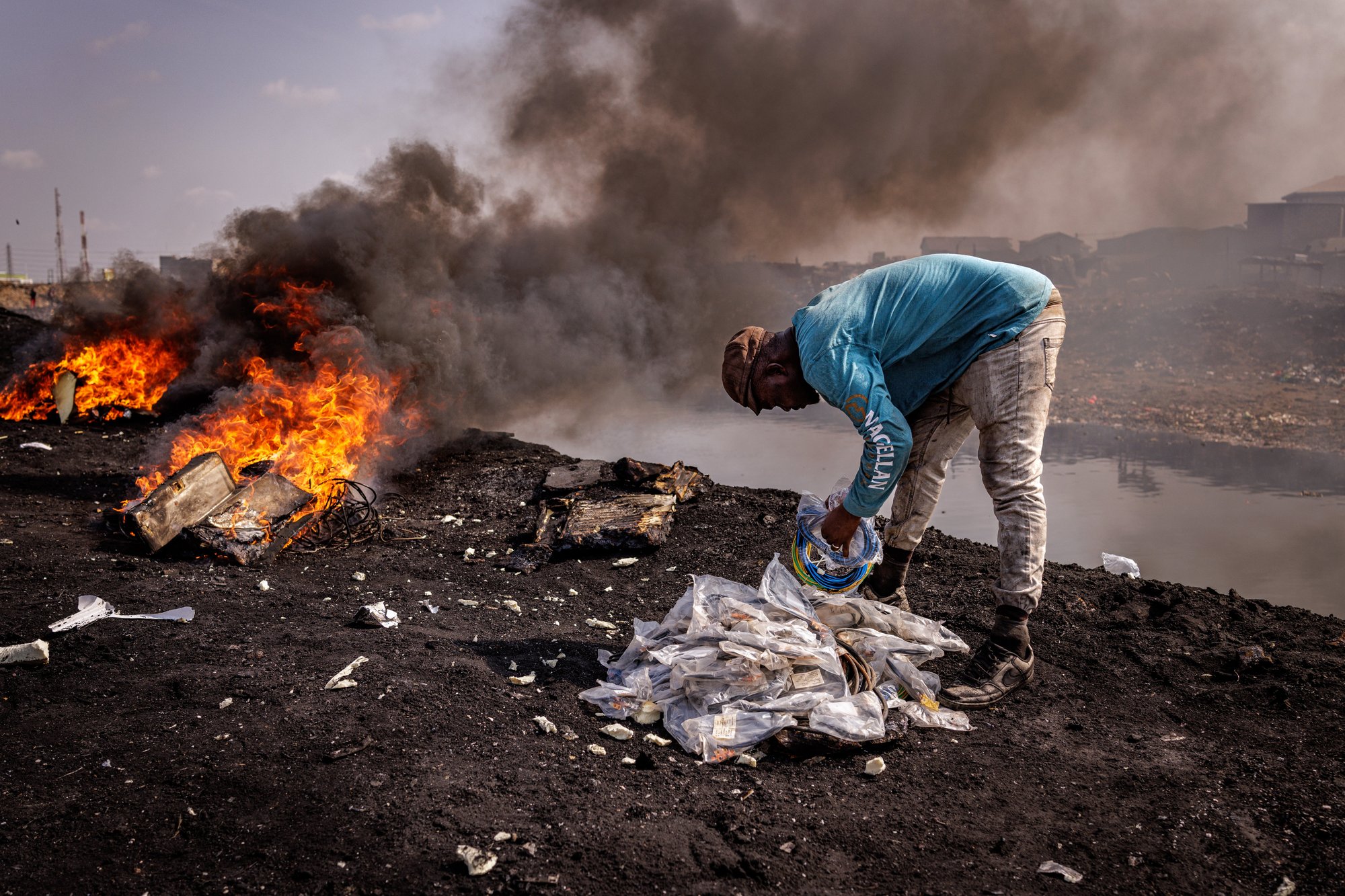
The labor is grueling. A single bag of wire can take an entire week of scavenging and gathering to fill. The value lies in the copper. Workers who gather wire can spend days collecting enough material to make it worth burning. Those who control the burn process extract the final value. One worker told me he earns roughly seven dollars per kilogram of cleaned copper when he controls the burn himself. The margins are thin, but the difference between gathering and burning matters.
As the insulation melts away, the wires crack and snap, releasing thick black smoke. When the wind shifts, the pits feel like open furnaces. Some of the men working the fires are fasting for Ramadan. They spend the day in heavy smoke and heat without drinking water, continuing the work as the sun moves overhead.
Once the insulation is gone and the copper is bare, the supply chain moves. The finished copper is sold to Nigerian buyers, who act as the primary brokers. From their hands, the metal is redistributed and sold off to a network of international buyers, disappearing back into the global manufacturing machine.
Small fires flicker across the dark. No structure. No coordination. Just heat, smoke, and the search for copper.
The larger burn sites begin to thin, but the fires do not stop. They spread outward into smaller, informal spaces — alleys, backyards, and open ground. The burning becomes decentralized. Men who spent the day gathering wire move to process it themselves, outside the larger groups.
There is a noticeable caution in how the work continues. The larger groups avoid burning after dark, and what remains is quieter, more concealed. Fires are kept smaller. Movements are more deliberate. Those who continue work do so carefully, aware of the risk of being seen.
Keeping the burn means keeping a larger share of what is earned.
What remains constant is the smoke. At night, it settles lower, moving through homes and narrow passageways before drifting outward into the city. It clings to surfaces, to clothing, to skin.
The wind carries it toward the bridge — the same ground where women sit and children gather. It moves across the water into the settlement beyond, where people are resting, where children are still playing. There is no separation.
Within minutes, the throat tightens. Within an hour, the lungs begin to feel it — a heaviness that lingers. There is no clear boundary between where the burning ends and where the city begins. The reach of it is constant, and it does not stop at the edge of the fire.
Trying to measure the environmental damage here is nearly impossible. Rusted oil drums leak into the soil. Studies have found elevated levels of heavy metals — lead, mercury, arsenic — in both the soil and nearby waterways. For the men working here, the calculation is simpler. They work. They burn. They survive.
Elsewhere, the world is accelerating. Electric vehicles replace combustion engines. Solar infrastructure expands. Devices multiply. Drones. Everything has a lifespan. And when it ends, it goes somewhere.
As we begin to leave, a cart arrives loaded with car batteries. Five men follow behind carrying machetes. They dump the batteries onto the ground and begin splitting them open where they stand. Acid and water spill from the casings and run down the embankment toward the river. The lead plates are taken for scrap. The rest disappears into the soil.
There is a brief warning to keep distance — if the acid touches clothing, it stains; if it reaches the eyes, it can blind. The batteries themselves carry the same instructions: corrosive acid, risk of explosion, no smoking or open flames, eye protection required. None of it changes how the work is done.
The nearest safeguards feel far removed from here.
At the base of the bank, a small bird stands at the edge of the water where the runoff gathers.
The world produces more electronic waste each year, and only a fraction is processed safely. The rest moves through systems like this — dismantled, burned, and sold piece by piece.
This isn't just a scrapyard; it is a lifeblood, however poisoned. The damage being done is unrelenting, yet for the thousands who gather here, the immediate sting of poverty is far louder than the slow creep of the toxins.
They are tethered to the world's discarded excess by a knot that no policy has yet been able to untie. If anything is clear, it is this: the fires were never extinguished. Life continues around them. By morning, it is just another day.
Alexander Carrigg is an American photographer and freelance journalist documenting issues of historical significance including political unrest, conflict, and humanitarian crisis. AlexanderCarrigg.com